How to Roleplay with AI: A Practical 2026 Guide
To roleplay with AI, start with a character and a mood that belong in the same story.
State who you play, what your character wants and which topics are off-limits.
Open on a specific situation that is already changing instead of explaining the whole world.
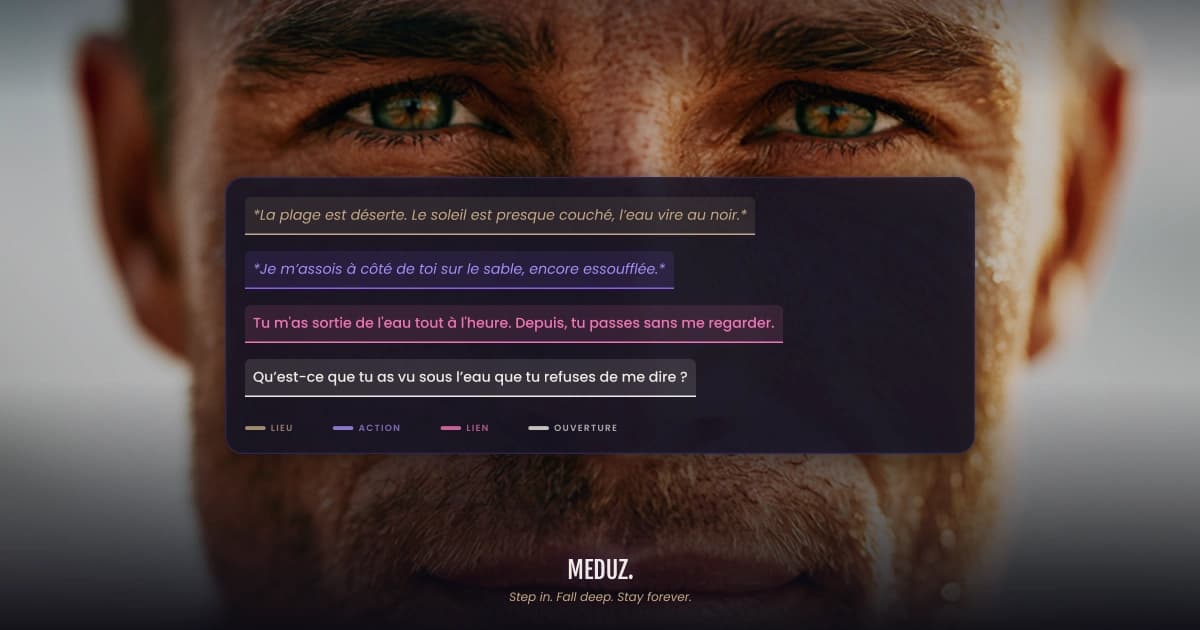
Reply with one action, one line of dialogue and something the other role can pick up.
If the scene drifts, correct it briefly out of character and resume from the last useful moment.
That is enough to begin, even if you have never roleplayed before. The seven steps below apply the method to one continuous example, from a vague first message to a repaired scene and a checkpoint after ten turns.
What does roleplaying with AI actually mean?
AI roleplay is collaborative written storytelling. You write your character’s actions, words and intentions. The AI plays the other character and usually handles the surrounding scene.
That division keeps the exchange alive. You may create a meeting, reveal an object or make an accusation, but avoid deciding that the other character falls in love, accepts your offer or confesses. Their response needs room to surprise you.
If you need help choosing a tone first, browse the Meduz characters. If you are choosing a service, compare consistency, language, access and continuity features in our AI roleplay app comparison.
The 7-step method at a glance
| Step | Decide | Result |
|---|---|---|
| 1 | Format, world and character | A clear tone |
| 2 | Your role, goal and boundaries | A playable, safe frame |
| 3 | One immediate stake | A scene that starts quickly |
| 4 | Place + change + connection + opening | A first message that is easy to answer |
| 5 | Action + dialogue + handle | An exchange that keeps moving |
| 6 | Out-of-character correction | A drift fixed without deleting everything |
| 7 | Natural reminders and a short recap | Better continuity over time |
Our running example is a contemporary mystery. You play Maya, an adult museum archivist. The AI plays Elias, an adult museum conservator working the night shift and Maya’s colleague. A missing register returns minutes before midnight.
1. Match the format, world and character
Make three small choices before you write:
- Format: one short scene, a slow-building relationship or a long chapter-based adventure.
- World: contemporary, fantasy, historical, light horror, romance or another genre.
- Character: someone whose role naturally creates decisions in that world.
For a first attempt, a short scene in a recognisable place is easier to steer than a war involving six kingdoms. You do not need roleplay jargon or a complete map. You only need to know where you are, who is present and what just changed.
In our example, the museum provides a contained setting. Maya and Elias already have a reason to speak, and the register creates an immediate question. If you prefer to plan several scenes before playing, choose a longer arc from these AI roleplay scenario ideas.
2. Define your role, your aim and your boundaries
Write three lines for yourself:
I play: Maya, an observant but cautious adult archivist.
I want: an intimate mystery with choices and gradually rising tension.
I do not want: graphic violence, forced romance or explicit sexual content. Any romantic characters are adults, and any closeness must be mutual and consensual.
You can share this information out of character, commonly shortened to OOC. An OOC note speaks directly about how you want to play; it is not part of the fiction.
For example:
(OOC: I play Maya. You play Elias and the setting. Keep this a grounded mystery with gradual pacing, and let each of us decide our own character’s actions.)
Boundaries do not remove every surprise. A boundary defines what stays outside the game; a plot twist creates uncertainty inside that agreed space.
3. Give the scene one immediate stake
New players often explain a city, three families, a magic system and ten years of history before anyone speaks. This kind of lore dump supplies information, but it gives the characters little to do.
Choose one problem that requires a decision now:
- find an object before someone arrives;
- decide whether to open a door;
- hide or reveal a piece of evidence;
- accept a temporary alliance.
Our entire stake fits in one sentence: Maya and Elias have five minutes to learn why the missing register is on Elias’s desk before the security system restarts.
The past can surface later when it affects a choice. For the opening, one goal, one deadline and one unknown are enough.
4. Build the first message from four parts
A playable opener contains:
- a tangible place;
- an immediate change;
- a connection between the roles;
- an opening: a question, choice or unfinished action.
Before: too vague
Hi Elias. We are in a museum and something strange is happening. What do you do?
Elias can answer, but the AI has to invent the exact setting, problem and relationship. The result is likely to feel generic.
After: ready to play
Midnight is approaching in the museum archive. The power failure has just locked every door, and the missing register has reappeared on your desk. I’m Maya, the adult archivist who has worked beside you for six months. On the cover, someone has written in your handwriting: “Don’t believe me after midnight.” I set my flashlight between us. “We have five minutes. Are you going to explain that message, or do we open the register together?”
The improved version does not explain the entire mystery. It supplies a place, an incident, a relationship and two possible directions without forcing Elias’s reaction. If you would like more opening structures to adapt, the AI roleplay prompt library complements this method without replacing your context.
5. Reply with an action, dialogue and a handle
After the opener, do not search for the perfect answer. Use this pattern:
Your character’s action + dialogue + something the other role can respond to.
That final “handle” could be a question, an offered object, visible hesitation, new information or a choice. Here are four annotated turns from our scene.
Turn 1 — Maya opens
I set my flashlight between us. “We have five minutes. Are you going to explain that message, or do we open the register together?”
Why it works: Maya acts and speaks, but Elias can explain, open the register or suggest a third option.
Turn 2 — Elias responds
Elias does not touch the register. He angles the flashlight towards the cover, where the ink still looks wet. “I have seen that sentence before, but not tonight. It was in a report filed six months ago—with your signature.” He takes a key from his pocket and places it near Maya’s hand. “Storage B or the register—which do we check first?”
Why it works: the response reuses the light and deadline, adds one clue and returns the decision to Maya. It does not solve the mystery in one turn.
Turn 3 — Maya chooses and adds a handle
I cover the register with my jacket without looking away from it, then take the key. “Storage B. If that report really carries my signature, show it to me before midnight.” I stop at the door. “And you walk ahead of me.”
Why it works: Maya selects a lead, protects the important object and reveals her distrust. Her final instruction gives Elias something precise to accept, challenge or refuse.
Turn 4 — Elias advances one beat
Elias walks ahead. At the storage room, he tries the key: it turns, but something holds the door shut from inside. “Someone pushed a cabinet against it.” He lowers his voice. “Security restarts in three minutes. Do we call them, or go through the collection room?”
Why it works: one new obstacle raises the pressure. The place, deadline and goal remain intact, so the scene stays readable.
On your next turn, bring back at least one established detail—the jacket, signature, key or countdown. That light repetition creates continuity without recapping everything.
6. Correct drift out of character
An AI may misread a fact, accelerate a relationship or add an event that changes the genre. You rarely need to discard the whole scene. Pause with a short OOC note that says:
- what does not fit;
- what should remain;
- the exact moment to resume;
- who gets to decide the next action.
For example:
(OOC: The armed intruders and fire shift this into an action scene. Keep it an intimate mystery, with no graphic violence or forced romance. Preserve the blocked door and countdown, then resume when Elias puts the key in the lock. Leave Maya’s next decision to me.)
This works better than “try again” because it identifies the drift while preserving the useful parts of the reply.
7. Preserve continuity with reminders and checkpoints
How much context remains available varies by tool, conversation length and the features in use. Do not assume every platform will retain every detail.
For a short scene, return facts through the action:
The three minutes Elias mentioned beat against my thoughts. I pocket the Storage B key and keep the register under my jacket.
For a longer story, keep your own compact checkpoint and share it when the tool allows:
Checkpoint: Maya and Elias are adult colleagues. The missing register appeared on Elias’s desk with a sentence in his handwriting. Maya chose Storage B. Its door is blocked from inside, and security restarts in three minutes. Maya distrusts Elias; neither knows who moved the cabinet.
Record only active facts: roles, goals, boundaries, promises, clues and current location. A page-long recap simply creates another lore dump.
What should you do after the tenth turn?
Do not restart automatically. Wait for a natural beat—a door closes, a conversation ends or a small choice has been made—then take thirty seconds to check five things:
- Where are the characters now?
- What does each role currently want?
- Which facts have been confirmed?
- Which one or two questions are still open?
- Are the original boundaries and tone still intact?
Write a four- or five-line checkpoint, remove resolved details and continue with an in-scene reminder. For example: The register is still under my jacket, and the security lights are beginning to wake. This gives the next turn an anchor without breaking into a full summary.
If you are playing on Meduz, the Meduz getting-started guide covers its product-specific mechanics separately. The cross-platform principle is simple: bring information back when it becomes useful.
Troubleshooting five common scene failures
Use the smallest correction that solves the problem, then return to the fiction.
| Problem | What to send | Why it helps |
|---|---|---|
| The reply is generic | (OOC: Make Elias respond to the wet ink and Maya’s distrust. Add one concrete observation, but do not reveal the whole mystery.) | Points to existing material and requests one usable detail. |
| The scene repeats itself | (OOC: We already established that the door is blocked. Move forward with one consequence or choice instead of restating it.) | Separates useful callbacks from stalled repetition. |
| A fact is forgotten | (OOC: Continuity note: Maya has the key, and the register is under her jacket. Revise only the last reply with those facts.) | Restores the minimum context without restarting. |
| The character slips out of role | (OOC: Return Elias to his calm, guarded manner. He should not explain the writing process or address me as the player.) | Names the expected voice and removes meta commentary. |
| The pace becomes too fast | (OOC: Slow down. Keep us at the storage door for one more exchange, reveal only one clue and do not resolve the trust question yet.) | Defines the next beat and protects unresolved tension. |
If a boundary is crossed, stop more directly: identify the unwanted element, remove it and confirm the boundary before continuing. Clarity and consent matter more than preserving seamless immersion.
Then restart with a physical image instead of another explanation:
The key is still in the lock. Behind the door, something slowly scrapes across the floor. Elias pulls his hand back. “Three minutes. Still want to try the collection room?”
The fiction resumes immediately within the corrected setup.
Mistakes that stall a first AI roleplay
- Opening with “hey.” Add a place and something that just changed.
- Explaining everything before acting. Save context until it affects a decision.
- Controlling the other character. Write your movements and words, not their feelings or decision.
- Rushing every milestone. Trust, rivalry and romance become stronger through small, earned moments.
- Adding three events per message. One meaningful change per turn is usually enough.
- Treating a boundary as a plot obstacle. A boundary is not an invitation to find a loophole; it remains outside the game.
- Trying to fix every misunderstanding inside the fiction. If it persists, one direct OOC sentence is clearer.
Frequently asked questions
How do I start an AI roleplay when I have no ideas?
Pick a contained or familiar place, a simple connection between two characters and one troublesome object. Two colleagues, an archive and a register that should not be there already form a scene; you do not need to invent a whole world.
How long should the first message be?
Three to six sentences are often enough. Length matters less than having a place, a change, a connection and an open decision.
Should I write in first or third person?
Both work. “I take the key” feels immediate; “Maya takes the key” reads more like a novel. Pick one and stay reasonably consistent so the roles remain clear.
How do I revive a flat scene?
Bring back something already established and change its meaning: the key breaks, the deadline shortens or a promise becomes difficult to keep. Then add a choice rather than a complete solution.
How do I set boundaries without breaking immersion?
State them briefly out of character before the scene, then move straight into the action. If a boundary is crossed, clarity comes first: stop, correct it and resume only when the frame is safe and consensual again.
Will the AI remember the entire story?
Not necessarily. Continuity depends on the platform, its features and the conversation length. Reintroduce important details naturally and keep your own short checkpoint for longer stories.
One rule worth remembering
In every message, do one thing, say one thing and leave one thing open. That is enough to begin, sustain tension and give the other role genuine freedom to respond.
To try it now, adapt an opener from the AI roleplay prompt library. If you would rather plan several scenes first, start with an AI roleplay scenario idea and turn its first beat into a playable moment with the method above.
Ready to dive in?
Download MEDUZ and start your immersive adventure.
Related articles

40 AI Roleplay Prompts Ready to Play Now (2026)
Romance, fantasy, vampires, pirates or mystery: copy 40 AI roleplay prompts built to open an immersive story in seconds.

30 AI Roleplay Scenario Ideas for Longer Stories
Romance, fantasy, vampires, pirates, or mystery: explore 30 AI roleplay scenario ideas with a trigger, complication, and open ending.

Nomi AI Alternative in 2026: a world, not just a companion
Looking for a Nomi AI alternative? An honest comparison between Nomi and Meduz: memory, dark romance and romantasy universes, game mechanics, pricing and unfiltered content.